Showing posts with label LBS. Show all posts

Friday, January 3, 2014

Citius. Altius. Fortius. Simul.

Since I don’t foresee The Huffington Post or Grantland contacting me anytime soon to freelance write for them, I’ll have to make do with Patel It Like It Is.  I’ve gotten several messages lately from around the world asking me what the heck type of workouts I’m up to based on my Facebook newsfeed.  Well, let me tell you about CrossFit. 

I’ll start at the beginning and preface this by saying I’m one of those people who drank the CrossFit Kool-Aid.   I joined CrossFit in fall 2012.  It was a weird period where I hated the world and felt like life was “happening” to me.   So, I joined CrossFit to get some sense of control back and fill the void left by the end of my rugby career.   Eighteen months and thousands of squats later, I can’t imagine not CrossFitting for the rest of my life.  So, what is CrossFit?   Well, in a nutshell, Crossfit is a fitness regimen of constantly varied, functional movements performed at high intensity in a communal environment leading to better health and fitness. 

Whenever you walk into a CrossFit gym (aka “box”), you’re guaranteed one of the hardest workouts you’ll ever have.  Crossfit.com and each box tends to publish their daily workouts (great for workout ideas if you travel for work).  The hour usually goes something like this.  Everyone does a warmup together to get you loose and ready for the rest of the exercises.  Then comes the strength and/or skill exercise portion for ~20 minutes.  This could include anything from back squats, pull-ups, handstands, bench press, snatches, pistols, etc.   Then comes the workout of the day (aka “WOD”).  This is usually a set of exercises done for time or a fixed time workout done for as many rounds as possible (aka “AMRAP”).  The challenging and fun part is that these workouts vary every single day.  At the end of each WOD, it’s common for people to be sweating profusely spread-eagled on the ground trying to catch their breath and hoping not to upchuck.   As we say, CrossFit never gets easier, it just sucks less. 


Squat cleans, December 2013

Ass-kicking lessons
I’ve played sports or pursued athletic endeavors as long as I can remember.  CrossFit is the only thing I’ve found to be a guaranteed ass-kicking each time while also being the most motivating thing you can do.  I’ll get to the motivating aspect in a bit, but to expand on the ass-kicking element, I’ll say this.  In a given class, you will see people of all ages, shapes, sizes, and fitness levels.  That gives you some accountability and something to aspire to.  As we say, you’re always chasing someone while someone’s always chasing you.  My times, weights, and scores are not close to anything worth bragging about, but they are improving.  And, I have role models for the type of CrossFit athlete I’d like to be eventually.  There are beastly 30/40-something year old mothers who kick my ass every day in the WOD.  I think that’s great that these women are doing this for themselves and becoming stronger both literally and figuratively.  

One woman (a former DI college athlete) from my box once quipped, “Honey, never lose your figure because it’s so hard to get it back.”  Haha.  Regarding figures, I’d say CrossFit is doing a world of good in redefining what “beauty” is for women of all ages.  Maybe the day will come when teenage girls desire to be “strong and lean” vs. “skinny”.  Since I began CrossFitting, I’ve gained ~16 pounds and my (expensive) jeans no longer fit.   Except for the pricey collection of 7s and Citizens that I now need to replace, I’m OK with the weight gain and pants size increase because I know it’s muscle.  My 15-year-old self would’ve reacted differently.  

I love CrossFit workouts because they are so audacious.  I remember when I was beginning grad school in London, I met an alum who was an Italian navy officer turned Bain consultant.   He said something that was so profound and something that has always stuck with me.  
“It is only when we operate at the edge of our limits can we exceed them.”  
I would argue that most people (including me) are operating in cruise control mode for the majority of their endeavors at work, school, hobbies, etc.   I look forward to CrossFit each day because I know for that one hour, I will be physically operating at 100%.  Over time that 100% relatively becomes my 90%, and I can see and feel that improvement/growth. 

I mentioned previously that CrossFit can be one of the most motivating things you can do.  Part of that is because it’s a fitness philosophy or system that works.  We also have great coaches that cheer you on and push you to do your best.  Trust me, if you have someone like Coach Logan yelling behind you “Run like is bear is chasing you!” or (my favorite) “Payal, row like your ass is on fire!”, you will run and row faster.  Haha.  Coaching that emphasizes form and safety, snarky commentary, and someone just pushing you to do better actually makes you improve.   


Squatting well below parallel, August 2013

Furthermore, I’ve found that CrossFit has helped me to identify the subtle differences between smart strength and brute strength.   In strength training, form matters in that there are better/more efficient ways of doing things.  It’s a bit of smoke and mirrors.  An example would be the first time I did power cleans in a WOD.  I had no idea really what I was doing, and afterwards, Coach David came up to me and told me to treat a power clean like a kettlebell swing by using my hips to pop the weight up.  He told me, “Payal, put a little ass into it, and the heavy bar will float up”, and it did!  Another example would be when Coach Yannick from CrossFitAKA in Amsterdam taught me how to conserve energy by landing in the squat position when doing 20” box jumps.   I can think of so many examples of this type of great coaching I’ve received from the official coaches as well as other CrossFit members (very common for us to teach and learn from each other).  


Kettlebell Swings, January 2013

CrossFit Camaraderie 
I’m motivated to CrossFit largely because of my fellow CrossFitters and the culture of the organization.   It’s not uncommon for people to tell me that they think CrossFit is a cult.   Everyone is allowed to have their opinion, and I’m not offended by this comment.  I choose to think of CrossFit as a community.  Throughout my life, I’ve always found that anytime you can work, study, worship, or live in community, good things will happen.  I believe CrossFit is a community full of achievement junkies who just believe in better.  It’s a community where people encourage and cheer each other on in the box, in competitions, and in life.   It’s a community where failure is celebrated.  It’s a community where people say “please” and “thank you”.  It’s an egalitarian and accepting community where your socioeconomic status and place in life matter less than what you value and where you’re headed.  And like my alma materit’s an incredibly positive environment.   Whether you call it a cult or community, I’ll self select into that type of place any day of the week.

It is a bit weird to think that people who individually workout together can have such a strong feeling of connection, isn’t it?  I remember one of my co-workers once quipping, “We connect through our vulnerabilities.”  I almost laughed out loud and thought that was some royal bologna.  But, on second thought, I think there’s a nugget of truth to it.   CrossFit is not “glamourous”.  Most people look terrible at the end of the hour.  Sweat, blood, dirt, vomit, spit, grunting, etc. are all familiar to us.   And you publicly struggle.  And it is this vulnerability and shared set of experiences that create intense camaraderie just like in any other team sport.  


CrossFit Evolving (London) birthday party, October 2012
http://www.crossfitevolving.com


AllSport CrossFit Football Combine Workout + Flag Football, August 2013
http://allsportcrossfit.com

Earlier this year, a friend forwarded me this provocative New York Times article on why it’s so difficult to make friends after the age of 30.  Sociologists since the 1950s have identified these three conditions as crucial to making close friendships: 1) proximity; 2) repeated, unplanned interactions; and 3) a setting that encourages people to let their guard down and confide in each other.  Through this lens, it’s easy to see why it’s so easy to make friends in college.  And, I’d argue the same for CrossFit.  Your fellow CrossFitters likely live or work close to your box.  And while you do see each other fairly often, you never know who’s going to show up in your class as peoples’ schedules are always shifting.  And again, as mentioned, when you’re working out, you’re gross and a bit vulnerable, which encourages people to let their guard down.   If any person from either my London or Houston box ever came up to me needing a favor that I had the ability and means to provide for, of course I would.   And that sentiment to go to battle with/for each other is a very common shared feeling.


CrossFit as a Global Sport (and Business)
When you think about it, there aren’t that many sports out there that have global appeal and participation.  Baseball may be America’s past time, but you won’t find many jerseys in Poland.  And while netball is popular in Europe, you won’t find many playing the game on this side of the pond.  The sports I think of as "global" tend to be popular ones in countries that were part of the British empire (e.g. soccer, cricket, tennis, rugby).  Or mainstay Olympic events like track & field.   And while there are examples of certain sports actively pushing for exposure beyond current boundaries such as the Premier League now broadcasting games on NBC Sports or the NFL committing to three regular season games being played in London at Wembley in 2014, it takes a while and loads of investment to build (and monetize) those brands globally. 

And then I look at CrossFit.  I had a chance to meet Adidas CFO Robin Stalker when I was in London.  He spoke about the rationale for Adidas’ brand Reebok for partnering with CrossFit and the investment that went into re-positioning Reebok as a fitness brand.  CrossFit from day 1 was the global sport of fitness.   Think about it, ESPN broadcasts the CrossFit Games every year, and athletes from all over the world compete for $1 million and the title of “fittest on earth”.   

I think of CrossFit as the McDonald’s of fitness in that wherever you go in the world, you will have a consistent fitness experience delivered by an organization with a strong culture and deeply ingrained values.  Whenever I travel domestically or internationally, I’ll log onto crossfit.com and type in a zip code in the affiliate finder tool.  I can usually find a box and will then email the owner to see if I can drop in for a workout (and usually pick up a t-shirt too).    I’ve done this for about 20 boxes in the US and also in 8 countries.  And, everywhere I’ve gone, it’s very much plug and play.  I know what to expect in terms of movements, general routine, and standards.  And because unique terminology and acronyms are used, there is a common CrossFit language wherever you go in the world.   And there’s further standardization with the benchmark girl WODs and Hero WODs named after military heroes.  Think of it like hurricanes, if you say “Hurricane Rita”, people instantly know what you're talking about.  Same thing with benchmark and hero WODs.  When my coach in London tells me we’re doing Fran, I know instantly that’s 21-15-9 of thrusters and pull-ups.  This workout standardization also allows for global comparisons of my times/weights/scores to other people regardless of nationality.  That's part of the secret of building a global sport.


CrossFit Aggieland, April 2013  (Fantastic box!!)

http://crossfitaggieland.com


CrossFit NYC Black Box, March 2013 (Don't bother going here!)

The other part about CrossFit that has always intrigued and excited me is that it promotes entrepreneurship.  This very well-written article explains the business and ethos of Greg Glassman’s CrossFit.  Essentially each box or affiliate is independently owned and operated.  The “affiliate franchise fee” tops out at $3,000/year and because the equipment tends to be free weights in locations that tend to be warehouses or strip malls, the startup costs are "reasonable" compared to other small businesses.   

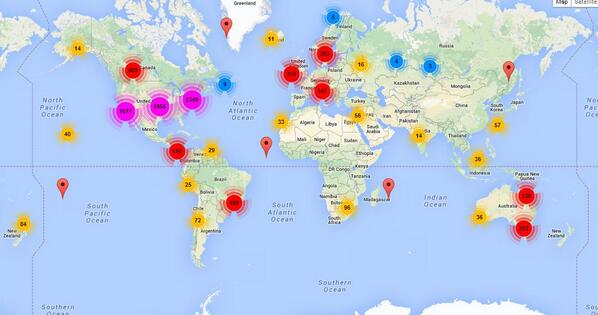
As this affiliate map shows, there are somewhere around 7,000 affiliates around the world.  From my own observations, most tend to be single-location businesses, so that means there are likely 6,000+ people making a living running their own CrossFit business.  (As an aside, I have seen a few CrossFit “chains” like CrossFit Copenhagen which has about eight separate locations).  I think that’s awesome.  

Embedded image permalink
CrossFit affiliate map, January 2014
Furthermore, CrossFit has a strong military element in it with the number of military members who CrossFit, the hero workouts, and common values.  I’ve noticed that several of the boxes I’ve visited are owned by ex-military personnel.   In business school, I noticed how our country doesn’t do that great of a job helping our soldiers find their next career after they’ve served their time.  I’m glad that many ex-military personnel have found their calling as CrossFit owners.     

Better Together

All else equal, I love CrossFit because it’s made (and continues to make) me a better person.   I’ve learned about my mental weakness but also my mental toughness.  Anyone who has done Murph has learned that, and I give credit to my London coach Stretch for first teaching me how to “chip away” when I desperately wanted to quit Angie.  

CrossFit has encouraged me to increase my protein consumption.  As a vegetarian all my life, I’ve just accepted being protein and iron deficient, but nowadays protein shakes, eggs, and nuts are part of my daily diet.  

CrossFit has made me a better runner, and if I still played rugby, I know the same.   I think of CrossFit as a “multiplier” in that it helps you in the rest of your fitness and sporting endeavors.  I imagine that’s why many professional athletes incorporate CrossFit into their training regime.  As a personal example, I ran my best half marathon time this fall in Istanbul with very few training runs.  I believe CrossFit is the missing link in that paradox.  

CrossFit has made me less of a hermit through our happy hours, birthday parties, road trips, Facebook conversations, and daily interaction.   My CrossFit friends are certainly not my closest friends, but in an odd way I count this motley crue as some of my dearest friends.  


AllSport CrossFit Christmas Party + White Elephant Gift Exchange, December 2013

CrossFit has given me a refreshed confidence.  It’s hard to explain, but just knowing that you can deadlift 1.5x your bodyweight or squat 1.3x your bodyweight is empowering.  I sometimes find myself “sizing up” other females in the grocery store or around town and thinking to myself “I could take her”.   

And as a woman who has always struggled to find other women I can identify with, I’ve certainly found some ladies who exhibit behaviors I’m trying to build into my character.  One woman in particular is my Houston coach Susie.  Twenty years down the road, I hope my kids, family, friends, and professional colleagues are impacted in the same way that Susie has impacted those around her because she’s certainly living my dream. 

The official tagline of CrossFit is “Forging Elite Fitness”.  That’s good, but if it were up to me, I’d borrow from the Olympics and amend to “Citius, Altius, Fortius, Simul” meaning “Faster, Higher, Stronger, Together.”  


SDHP, December 2013


Ring swings during the "12 Days of Christmas (fave WOD ever!), December 2012


Squat therapy, August 2013


AllSport CrossFit Fine Looking Friends!  December 2013

Sunday, April 14, 2013

Oxheart

Even though I live with my sister Binita, we don't see each other alot.  She has a crazy shift schedule while I have a corporate job with a CrossFit addiction.  Anywho, when I came back to the US, my sister mentioned there was a fancy new restaurant in Houston called Oxheart that was all the rage.  A week later my sweet friend Preeti mentioned she had been there and loved it.  And then the following week, one of my co-workers mentioned it too.  So, I decided to make a reservation for Binita and me as a "sisterly dinner".  I knew it had to be good if I had to book a reservation six weeks out and at 9 pm.  


Last Monday finally came.  The restaurant called me a couple of times to confirm, left a voicemail message, and sent a text (overkill).  Binita drove and was freaked out that Oxheart is in a dodgy part of Houston (north of downtown between 45 and 59) and scared that someone would key her fancy Infiniti SUV.  I told her to chill, there were other pricey cars parked next to the ditch.  We walked up and could tell there was a restaurant in the building through the windows; however, it took a while to find the wooden door.  It pisses me off when establishments don't even have a sign on the door.  For the record, it's the angled wooden door on the corner.  Not the club next door with trash bags out front.

We walked in to find a cozy restaurant with about 10 small tables and a U-shaped bar overlooking the kitchen. The host told us our table wasn't ready and offered us two uncomfortable metal chairs next to the restroom.  Again, I was pissed.  If I had to wait six weeks for a reservation, I expect my table ready when I get there.  This is Houston, people.  We saw waiters running about, the host incessantly refilling the silverware drawers, and no one really paying attention to us.  15 minutes later, a woman comes by and senses we're a bit perturbed.  She offers us a free glass of champagne to sip while we wait (of course I agree!).  10 minutes later, we're still waiting, and I'm wondering if we could just sit on the bar.  I pull the waiter over and ask him if the empty seats on the bar overlooking the kitchen are available.  He said that those seats do have the same menu as the rest of the restaurant.  I'm thinking to myself, "Well, why the hell did you not offer me these bar seats overlooking the kitchen half an hour ago when I was on time for my reservation?!?"  I almost wanted to strangle him, but the rest of the evening made up for the rough front of the house experience.  And, quite frankly sitting at the bar is a cooler experience than one of the small tables.

We got situated on the bar where we saw 6 or 7 chefs meticulously preparing every dish using forceps, a hundred different plastic containers, and other cool gadgets.  The two waitresses wearing leather aprons were lovely and definitely knew their stuff.  For wine, we ordered the 1999 Kalin Cellars Semillon.  The waitress mentioned that Oxheart is the only restaurant in all of Texas that serves this wine.  Apparently, the sommelier knew it was good stuff and bought all the bottles the vineyard had barring distributors from getting it.  It was an interesting dry, sweet wine that tasted like nothing I had ever had before.  It was darned delicious and a good choice by the waitress.

Binita and I both ordered the garden 4-course tasting menu for $49/person.  For an extra $30, you can get wine pairings for each course, but we were happy with our semillon.  Below is the menu we had, and I'll do my best to explain things from my perspective.

  • warm sunflower seed soup, burnt onion, puffed rices and grains, pumpkin seeds, black tea
  • heirloom carrots cooked with exotic spices and coconut, avocado, corianders
  • cauliflowers cooked in different ways, raisins and currants, brown butter, mustards
rye bread and sunchoke pudding sweetened with molasses, yogurt, and strawberries.

First course was that sunflower seed soup.  That was the most flavorful, potent soup I've ever had, and it's incredible that emulsified sunflower seeds are the base.  There were some intense flavors and all sorts of textures going on in that dish.  And the chef comes out and pours the soup in your bowl from a tea kettle explaining the 50 dry ingredients at the bottom of the bowl.  The soup actually was my least favorite course because it aggravated a sore I had on the edge of my tongue.   It's also a very heavy soup and surprisingly filling.  Oxheart usually swaps out items on the menu every month based on what's in season, etc.  This soup has been on the menu six months.  So, even though I didn't care for it that much, others obviously do.

The chef brought out warm, soft mini English muffins with spiced butter/lard after the first course. YUMMY!!

Second course was a beautiful montage of carrots sourced locally.  They base was a stack of seasoned carrot chunks covered in a yummy puree with carrot disks and flowers meticulously placed on top with forceps.  My description isn't the best because it's hard to explain, but boy howdy that dish was yummy.   This was my second favorite course.  And again, it is surprisingly filling.


Third course was cauliflower cooked several ways in brown butter.  I normally hate cauliflower, but man, that dish was damn delicious.  Binita and the waitress say it's because of the brown butter.  I would eat that cauliflower dish any day of the week.  And, it's a sign of a good chef if he can get guests to like things they normally don't.

Last course was a slightly savory dessert of rye bread pudding.  No lie, it looked a little gross, but I did think it was an appropriate end to the meal.  And, the whipped yogurt and caraway-infused strawberries were amazeball.  Because I was SO full, I couldn't finish dessert.  Lesson for next time, pace yourself and save some space in your tummy for the end.

At the end of the meal, the chef brought out some chocolate spiced hazelnuts that were to die for.  I asked the waitress how they were made, and she said the chef's secret was to put extra salt in the dish to contrast the sweetness.  At that point, I wanted to jump out and say, "I know!  I know!  That's what I do with all my desserts too!!  Case in point, compost cookies."  But, Binita was giving me the evil eye that we needed to get home since it was almost midnight.  

Overall, I enjoyed Oxheart because it was a food adventure.  This place is all about food and reminded me of the El Bulli case we discussed in my first year Marketing course at London Business School.  El Bulli was a restaurant in the Catalan region of Spain and started by Ferran Adria.  It was named the best restaurant in the world a record five times and is said to have pioneered molecular gastronomy with it's food lab in Barcelona.  El Bulli  was only open a few months a year, a two hour car drive away into the middle of nowhere, and next to impossible to get a reservation at.  But, it was a foodie's Mecca.  El Bulli actually closed in 2011, and Ferran came to LBS and HBS to ask students to help him come up with a new business model for his culinary talent as a student competition.  Unfortunately, I couldn't participate as my school life was already packed.   One of the takeaways from that Marketing case discussion was that an optimal customer experience can vary, and customers can't always articulate what they want.  Getting a reservation and traveling to El Bulli was a pain in the ass, but that added positively to the customer experience paradoxically.  And, when it came to the food, no one walked away disappointed.  Again, El Bulli focused on what it was good at: food.  My experience at Oxheart reminded me of El Bulli.

I actually saw a fab TED talk yesterday that echoed this concept.  It's by Dan Ariely, the author of "Predictably Irrational".  I had heard of the book in my Incentives in Organizations elective at LBS, but I haven't gotten around to reading it because my "to read" queue is forever backed up.  Anywho, I highly recommend watching this TED talk!  One of the best parts is where he talks about IKEA furniture that takes forever to assemble.  The effort that goes into building my IKEA furniture actually makes me like it better!  The cake mix example is so great too...haha!  See it here: http://www.ted.com/talks/dan_ariely_what_makes_us_feel_good_about_our_work.html

Back to Oxheart, I think there's a similar reason why I enjoyed the experience.  I had to wait six weeks to get a reservation, deal with some bad service upon arrival, shell out $150 for the evening, etc.  But, I take pride and am happy because that experience was authentic and had meaning.  To have and see the chef owner meticulously place flowers on my carrots with forceps made me feel like I was the only person in Oxheart, and his willingness to answer all my foodie questions revealed his expertise and passion.   People don't buy what you sell, they buy why sell it.  I walked out of Oxheart physically very full and emotionally inspired.

The very next day, the New York Times actually reviewed Oxheart and another Houston hotspot called Underbelly.  Read about them here: http://www.nytimes.com/2013/04/10/dining/reviews/making-houston-a-dining-destination.html?pagewanted=all

Sunday, September 23, 2012

Payal Style

A few years ago, I had the opportunity to meet the famous and highly regarded Mrs. Moneypenny (her real name is Heather) at a TEDx event in London.   I was still new to Britain, without a television, and  preferred to read the WSJ over the FT each morning, so I wasn't aware of her celebrity at the time.  In any case, I was able to impress her unknowingly with my TED talk, and recently she was very generous in offering me some advice as I'm hunting for the right next career move.   I feel very lucky that I had that privilege, and this blog post is to share some of the privilege to the 5 people that actually read this blog (haha).   It's based on some thoughts I stewed over after reading Mrs. Moneypenny's Careers Advice for Ambitious Women and my own operating strategies of being a woman in a man's world.   Everyone needs to develop their own "style" taking things that work for them and borrowing ideas from others.  This is my "Payal style".

Confidence matters.  Alot.  Men tend to carry themselves with more confidence than women.  I don't know precisely why, but from my sample of classmates, friends, and co-workers, it's clear to see.  This confidence thing is an uphill battle I'll likely face the majority of my career.  But, at least I'm more aware of it, and can work to boost it in situations that matter.   Saw this a few weeks ago on Pinterest, and it's my new motto.


Theory #1.  I have a theory that you're an average of the 5 people you hang out the most with.  The company you keep speaks of you as well, so make sure you surround yourself and spend time with people whose values are similar to your own and will make you a better person.

Accept that life's not fair.  In 2010, a report was published by Huran listing the top 20 self-made women billionaires.  11 out of the 20 were from China.  There are a couple of contributing factors including high GDP growth in China, a culture that values ambition and hard work, and one special thing that I hadn't thought about before: cheap and stigma free childcare.  In America, it's much more difficult to outsource your home life, and I for one wouldn't ever want to.   That means I'm going to have to dial down my career at some point.

Be gracious.  One of my favorite Directors that I worked with is a woman named Courtney.  She once paraphrased a quote (I think by Laura Bush?) that has always stuck with me, and something I try to live my life by.  Forgive the inaccurateness of it, but it goes something like "True grace is making anyone, no matter what stage of life they're in, feel comfortable."

Everyone has to eat.  As a sophomore at Texas A&M, I was a student leader/mentor in a prestigious freshmen leadership organization called ASSIST.   I had 64 freshmen that I looked after, helped, and invested time in so that they would not only have a great college experience but also grow as leaders.  This was a life changing experience for me (and alot of fun), but it was an incredible time suck.  A guy in the class ahead of me named Brian gave some advice over a campfire handover session that has always stuck with me.  He said that while this experience would be incredibly time consuming for me the following year, remember that everyone has to eat, exercise, study, shop, do laundry, etc.  And, you should take others to do those things with you.  I've found this advice to be incredibly effective for me over the years.  In college, I ended up taking freshmen to go to the grocery store with me, go run around campus, or spend evenings in the library together.  What we did mattered less than the fact that I wanted to spend time and invest in them. Over the years, I've adapted this to my professional and grad student life.   I think it also brings a sense of genuineness and realness to relationships.  While I do enjoy going out to a fancy cocktail lounge or club in London, sometimes I'd much rather go explore apartments or help a friend prepare for a salary negotiation.

Get your rear in gear.  And go join a gym or sports team.  Physical fitness makes me feel better and is an endorphin rush.  Going for a run is how I de-stress and think about things.  And, my new favorite fitness programme CrossFit also helps build confidence and gives me a sense of community.  I feel all women should carve out at least 3 hours a week for physical activity.

Read something.  All. The. Time.  I have very low tolerance for people who don't read.  I'm busy, but I always have a book (fiction and non-fiction).  Reading helps me continue learning and "escape".  I think it also gives me interesting things to add to conversations.  I love trading book recommendations with friends.

Pay it forward.  I'm blessed to have a number of champions and mentors that have watched out for me over the years.  I can never repay them for the profound impact they've had on me, but I can pay it forward to the next generation.  Mrs. Moneypenny had a great saying for this targeted at females, "There is a special place in hell for women who don't help other women." Amen, sister.

Be proactive.  An incredible Managing Director I used to work with named Chuck mentioned something to me in my first month working out of college that has always stuck.  He said that I should be proactive in managing relationships with professional colleagues.  In his words, "The relationship has to be there before you need it."

Accept that men will not cross-stitch.  Some of my hobbies like painting and cross-stitching are very girly.  No man will ever want to do those things as a company outing or social event.  Develop (or at least attempt to develop) an interest in their hobbies.  It turns out I actually love playing poker, and I'm glad I learned the game in business school while playing with a good group of friends in a weekly small buy-in game.   I suck at golf (and managed to hit my study group mate Pete in the face with a golf club...not my finest hour), but eventually I'll get there and progress past the driving range.  I've always loved American football and joined my business school classmates in a fantasy football league this year.  My good buddy Sheldon (aka Mr. Whippy) came up with this great idea as a mechanism for us to all keep in touch given that we're spread over several continents.  It's been great to play fantasy football with them (and I have a great team that is dominating the league!).  They've been very accepting of me being the only female in our league too.  I think women sometimes play the "they won't accept me in their realm" card too hastily.

Ask for favors. I learned this in my Paths to Power class (GREAT class!) at London Business School.  Men are much more comfortable and willing to ask for favors, negotiate salaries, request special treatment, etc.  Women need to do this too (in our own unique ways).  We played a game in Paths to Power that has always stuck.  Essentially, we were put into breakout rooms with 10 people.  Each person wrote two things they needed help with on Post Its and then placed them on the outline of a giant circle drawn on a white board.  The Post Its had everything from requests for interview help to places to live to asking for a coffee during the break.  The students then drew lines from their names in the center to those they could help.  Once all the Post Its were cleared off, you could see the end result was a giant web.  Humans systematically underestimate others' willingness to help, AND we underestimate the happiness that performing favors gives them.

Know the PIE equation.  I went to a fabulous London Business School / Committee of 200 conference recently.   An accomplished fellow woman from the South named Tanya Fratto mentioned something to me that has stuck.  She had a very distinguished career at GE and told us how GE folks use the PIE equation for career progression.  Performance. Image. Exposure.  Each is equally important, and women should not only focus on the P.  Performance will not take you to the top, and the sooner females become comfortable playing organizational politics, the better.  Also, they can demonstrate organizational savviness in the their own unique way.  Tanya gave the anecdote of how a macho man questioned her ability to turnaround a GE plant in small town America.  Tanya coyly remarked that she was selected because she knew how to shoot guns and drove an F-250.   When put into situations like that, women can either get defensive and go into heinous bitch mode or react in a lighthearted way and win people over.

You cannot have your cake and eat it too.  I've always strived to be a renaissance woman of sorts, and I have an unrealistic belief that I'll be able to balance a career, family, personal development, etc.  Mrs. Moneypenny drives home this point that you can't have it all.  List your priorities and make decisions based on them.  You will have to say "no" and disappoint others.  I believe there's alot of merit in this, but it's incredibly difficult for me to do. 

Tuesday, June 19, 2012

Thankful for Interesting Conversations

I graduate from London Business School on Friday July 13 (yes, I'm wondering why that ominous date was chosen).  The most common question I've gotten over the past two years is along the lines of "what are you doing afterwards?"  And there's a subtle but overemphasized presumption in all of this that business school is solely a means to an end.  Yes, it is a great way to transition careers, advance in your current discipline, start a new venture later, etc.   But, for me, the point was rarely (close to never) about the afterwards part because I saw it as a truly transformational life experience.  One of my former clients (a great guy who got his MBA from Stanford) said this to me way back, and it's proven right (even for the cynical ones in my class).  I learned frameworks, how to articulate points, appreciate diversity and differences, question everything, realize there can be multiple "right" answers based on frame of "right", etc.   I also believe I'll be a better leader, manager, wife, mother, patron, volunteer, advisor, and friend because of this experience.

I go into nostalgic mode often these days as I'm sad to see these amazing two years end.  I am SO thankful for this experience that it brings me close to tears, and I don't know what to do with all of this thankfulness.  Since I've fallen off the cliff in blogging lately, I'm going to use this blog to explore that.  There has to be a "so what" or logical next step for me given abundance of gratitude.  I can give back to LBS with my time and resources later on.  But, is that it?

Reason #1 to be thankful: Interesting conversations

I was invited to a dinner at the Dean's home this evening and Terry Neill was one of the guests of honor.  Mr. Neill graduated from LBS in the 3rd MBA (formerly MSc) class and went on to join Anderson Consulting where he helped build the company from 300 people to +200,000 plus as Chairman of Anderson/Accenture.   He is a GREAT guy, and we had an interesting, interactive discussion with him + 10 students.  Some of the stickier things that I learned:

-Stanford professor Ray Levitt once said people don't change for rational reasons but rather emotional reasons (love, fear, hate, worry, etc.).  I don't quite agree with it completely but do think people are more likely to change and do so more quickly if there is an emotional hook.  Ideally, the rational arguments are packaged nicely with the emotional messaging.   There are so many examples I can think of that back this up from my Class Gift 2012 campaign...

-Accenture has two projects that are each worth +$1 billion.  One is helping the US Dept. of Homeland Security setup their systems and the other is with an energy company.  (Aside...hope my taxpayer dollars are  being used wisely.)   We now have organizations willing to spend a BILLION dollars to change systems/technology but not willing to make similar investments in people.  And people are infinitisimally more complex that binary computers.   Think about it.

-Notre Dame legendary coach Lou Holtz was giving a speech to business leaders at Harvard Business School once, and he was asked "How do you motivate your players each Saturday?"  Holtz thought a second and then replied, "My job is to not demotivate them on game day."   He then drove home the point to the corporate executives in the audience by asking them how many of their employees are motivated on day 1 of the job and whether they are still motivated.  Most aren't, and company leaders are responsible for this loss in motivation.  And, Terry argued (and I agree) that lack of trust is a driving force in this.

-A question to ponder:  Is human behavior predictable?   Some say yes...doesn't a stadium of football fans go crazy in sync when a goal is scored?  At the same time, I can think of so many situations where people react to situations in different ways based on their background, motivations, etc.   There's validity in both these points, and I feel the truth is in the middle.  I think there are certain universal human reactions to events and generalizations on how different people (ex. nationalities) will react to situations and make decisions.  Good managers can identify these broad buckets of predictable behavior.  Great managers are able to take this understanding a step further and can understand/read people within these categories.

-Employees must understand the customer and know "why" they are important.  Terry brought up an example of an Accenture client engagement with McDonald's many years ago.  The average tenure of a burger flipper in NYC was 32 days.  (Whoa.)   Some forward thinking McDonald's managers knew they had to bring some meaning to the daily task of burger flipping, so they invested in educating these employees on the customers - who they are, the economics of the business, best practices, etc.  Eventually, average burger flipper tenure rose to 4.5 years.  People (and customers) don't care about what you do as a company, they care about the why.

-There are 15 million Jews in the world.  That number seems surprisingly low to me given how strong, pervasive, and influential they are globally.   All over, most Jews have rich traditions, generally consistent behaviors, much recognition, etc.  Jewishness transcends the small (national) borders of Israel better than any other religion.  This factoid came up as we were discussing this trend of people identifying more with lifestyles than nationalities...call them glomads ("global nomads").

I had no idea what this evening was going to entail.  I thought it was just drinks but then found out it was a formal dinner event.  It was a lovely evening, and I came home energized after the interesting conversation with such an accomplished, curious, diverse, and helpful group of people that I feel blessed to have in my personal community.


Thursday, March 8, 2012

Leaving on a Jet Plane

Yesterday, I attended a lunch & learn hosted by our London Business School Marketing Club (they do GREAT events).   The guest speaker was Rob Britton, a professor turned airline executive.  He spent over 20 years at American Airlines and left as Advisor to the Chairman.   In the 1970s, Rob helped launched AAdvantage, the first airline loyalty programme, and his seminar focused on the value of these frequent flyer programmes (the only marketing tactic that has really worked for airlines).

A few random factoids and musings I wrote down in my Moleskine about this challenging yet very interesting industry:
-There's significant spoilage by the very nature of the service.  Weak demand, stiff competition, overcapacity, etc. leads to empty seats.  A surprising 20% (!) of seats flew empty on flights last year in the United States.

-The airlines business has relatively low barriers to entry (not good from a firm standpoint).   And, on top of that there are high exit barriers.  New airlines seem to sprout up every year but think about how they don't go away as often.  Once an airline goes belly up, the assets (planes) are worth more cobbled together as a going concern than grounded separate planes.  And I don't imagine the secondary market for used (and many times old) aircraft is so great when the industry already has an overcapacity problem.

-The innovation in the industry has to come from customer experience (legroom, wifi, food, online distribution, etc.) and not the actual product or service (fast, long travel).  For over 30 years, most airplanes fly between 500-600 mph, which is slower than the speed of sound.  I don't quite understand all the physics behind it (need a Khan Academy talk!), but once a commercial jet breaks the speed of sound barrier, it becomes prohibitively expensive because of the amount of energy required.  More interesting info here: http://www.physicsforums.com/archive/index.php/t-173394.html

-Travelers prefer frequency to differentiation.  Boutique aspirants have tried to carve a niche in this space but fail every time.  Imagine a Goldman Sachs employee chooses to fly one of these high end airlines from NYC to London.   If and when a meeting runs over or there is bad weather, one of the legacy carriers could book him or her on the next flight out that day.  With a boutique airline, she or he may have to wait a day.  This resonated with me.  When I travel for work and return home, I want to get there NOW and will pay anything to make it happen.

-If you added up global airline profits throughout time, the sum is a loss.  That's not too surprising and could be used to call for shutdowns or thwarting of future investments.   However, I think airlines are similar to banks, they lubricate the rest of the global economy.  And thus, I foresee subsidization and loss minimizing policies for at least my lifetime.

Rob is a very entertaining and energetic speaker!   He is quite generous with his time too and does a circuit of top business schools each year.  Am going to solicit his help with an idea I came up with to see if British Airways or Lufthansa would be willing to give LBS Class Gift 2012 student donors the perk of airline status for a year.  I see it as a win-win-win marketing tactic for the airline, the school, and students.  Fingers crossed!


Tuesday, February 7, 2012

Don't be an Insider

"The real voyage of discovery consists not in seeking new landscapes but in having new eyes." -Marcel Proust

This French novelist was on to something with this quote.  One thing business school has taught me is that learning and problem solving aren't always necessarily about learning new things or seeing new problems.  Sometimes, it's about framing.  Or the content and delivery channel.  By this, I mean that alot of the learning in the past two years has come from cases (real experiences) and lively discussions.

One of the more interesting learning opportunities came about a week or so ago when convicted insider trader Garrett Bauer shared his story with students at London Business School and candidly took Q&A.   This event came from left field when Garrett contacted our PE & VC club and offered to do this.  I heard second-hand that the PE & VC club agreed to host this event because Garrett had similar other speaking engagements at US business schools and wanted to include us in the mix.

Essentially, Garrett was a day trader who used inside tips from a lawyer (his best friend) to make buy / sell decisions.  He did this for several years, and while it didn't always pay off, it doesn't change the fact that he acted on privileged and confidential information.

Garrett went into great detail on the information he got, the logistics of the scheme, how he got caught, and what it was like to be in prison.  He was tried in federal court, and it was there that he learned that his best friend ratted him out.  In a strategic move, Garrett plead guilty and was convicted.  He is now awaiting sentencing.  That is largely the decision of the federal judge who will give a sentence ranging from ~8-12 years based on the points accumulated from all the charges (insider trading, obstruction of justice from destroying a cell phone, and money laundering from using cash from an ATM to pay for insider tips).   Factors such as volunteer work, marital status and children, sickness, and amount of money recouped can influence the sentence given within the sentence guideline.   I don't believe Garrett is evil, and he's found an interesting way to use his time to teach others based on his experience and to also potentially lower his sentence.  He's also found the right audience with MBA students, and I believe he is sincere in his message of "it's just not worth it".   Not only for insider trading but also other "victimless crimes."

The Q&A lasted at least an hour.  The softball questions at first became a bit more candid and interesting as time passed.  I asked Garrett whether he had had a chance to talk to his best friend / insider trading accomplice since he was arrested.  He said that he had not and that his lawyer advised against it (because it would then lead to another type of charge added to his docket).  From what I could tell, he didn't show overt anger towards his friend for betraying him (surprising).  I certainly wouldn't be that forgiving.

The message of "it's not worth it" really came through.  (Not that I ever have or will user insider info).   From the way Garrett explained, I would never want to be the target of the federal prosecutors.  They make sure that they can win most cases they take to trial.  And many of the rules, precedents, and calculations are assymetric in favor of the feds.   He also did this for a decade, and didn't make that much (or any) money for many years at the beginning.   Plus, he made good money anyways.  Definitely not worth it.

Sunday, January 29, 2012

Year of the Dragon

In January 2011, a few of my classmates decided to celebrate the New Year by jumping the fence and sneaking into Regents Park at night to light Chinese lanterns and toast with prosecco.

January 2012...we decide to make a tradition of it!  Our lanterns sailed much better this year given that it was much less windy (but equally cold!).   According to Chinese astrology, this is the year of the dragon, the mightiest of the signs.  Dragons are known for their dominance and ambition.  They live by their own rules and interestingly can feel unfilled and exhausted by their passions and enthusiasm.  I asked one of my Chinese friends how she traditionally celebrates Chinese New Year with her family.  Though different in specific traditions, there are striking similarities in how Western holidays are celebrated (great feasts, friends and family gathering, joyful greetings and optimism, parades, etc.).  I believe humans tend to overweigh the differences amongst cultures and discount the sameness.   This is an example.

I was curious to know what my Chinese zodiac sign is.  I was wanting some ferocious beast and was initially disappointed with the lackluster pig.  However, after actually reading about the character of pigs, I'm so happy I am one!!  Pigs are known for their diligence, compassion, and generosity.  They are giving souls (sometimes giving too much) and place a premium on honesty (which they expect to receive).  They have trouble asking for help (known pride issue), enjoy spending more than saving (ouch), and are astute bargain hunters (of course!).  Pigs can always be counted and are detail oriented.  And they enjoy opportunities that allow them to express their creativity.  I don't believe in astrology because I feel life circumstances and context (nurture) are as equally impactful as nature is in determining character.  However, it's hard for me to ignore how my Chinese zodiac sign perfectly nails qualities I aim for and am most proud of.   Just something to think about.

After our Chinese lanterns become specks of light in the distance and the bubbly was gone, we headed over to Berkeley Square.   My sweet friend Emily introduced me to this swanky area when we celebrated my birthday at Murano, an amazingly delicious Italian restaurant.  Another one of my friends ended up moving to this area and hosted a birthday gathering at The Only Running Footman (great pub on ground floor, two additional floors of fine dining, and an awesome chef's kitchen lounge on top floor).  If and when I land a job in London, I'm determined to settle in Berkeley Square :)

Pictures of the evening below.


Tuesday, December 27, 2011

Kaleidoscopes

On our last evening in India, a distinguished friend and advisory board member of London Business School invited us (a group of 35!) to a dinner party at her posh home in Mumbai.  Dr. Gita Piramal is a successful entrepreneur, author, philanthropist, and socialite.  And the word "home" is an understatement for the beautiful 10 story mansion her family occupies.  She gave us a heads up that she had taken the liberty of inviting a few special guests, so I thought that was fine.  Until we arrived and realized that she had assembled a "who's who" guest list for our event.  There were CEOs, influential journalists, leading lawyers, members of the Tata clan, the David Letterman of India, a leader of the Blackstone Group, and more.  Part of the game that evening for me was going around meeting people, trying to figure out who they were, and then finding out why we were both at the same dinner party.  It was an incredible and surreal experience...a perfect way to end our trek!  Dr. Piramal's generosity in opening up her gorgeous home, providing a dang delicious meal, and thoughtfully putting together the guest list was something I admired (and hopefully can mimic one day).   She mentioned that she purposefully put together this eclectic guest list because she wanted to create a kaleidoscope effect.  And I think it worked splendidly.  Different people, perspectives, areas of expertise, etc. all came together to create something beautiful.

The following morning, news of our dinner event was mentioned in the Mumbai Mirror (a supplement to The Times of India).  http://www.mumbaimirror.com/index.aspx?page=article&sectid=2&contentid=2011122220111222022340870edef2331

Wherever I travel, I usually have a mental association.  Some places remind me of feelings (e.g. Italy).  Some places remind me of history (e.g. South Africa).  Some places remind me of people (e.g. Aggieland).  Some places remind me of food (e.g. Greece).   And some places remind me of colors.  For example, Scotland (the greenest place on Earth) and Morocco (browns).  India reminds me of a rainbow or kaleidoscope.  Rarely or never will you walk into a retail shop to find clothes in simple black, gray, or white.  Usually, people where bold colors in combination.  Here are some kaleidoscope photos from my trip.


Saturday, December 24, 2011

Up in the Air


I’m home. Finally.

After spending the last two weeks in India, I get another two weeks in Texas.  In my penny pinching mode, I neglected to review in detail the route that STA travel gave me on this leg home.  I ended up spending a full 24 hours in the air and several more in airport layovers…ugh.   I learned that joints will swell with prolonged time in the air, and my wonky ankle suffered quite a bit (gah…I’m ready for this to heal already).   Anywho, I made it home and am now playing Christmas catchup.   Over the next few days, I’ll make some more India-related blog posts.  Excuse the backwards nature of this.

On my flight from Amsterdam to Atlanta, I sat next to a gentleman who was also on my Mumbai to Amsterdam flight.  A few courtesy words ended up becoming a 3+ hour conversation (and I generally avoid talking to people on airplanes).   John noticed the mehndi (aka henna) tattoo on my hand and asked if I went to an Indian wedding.   I thought it was quite perceptive and clever for him to guess that.  Over the next few hours, I learned that he married an Indian woman, has two kids with her, and makes a family trip to India each year.  He also quit his engineering job and is investing his retirement savings into producing a Bollywood film that he wrote.  This piqued my interest, and I couldn’t help but respect the fact that he is pursuing his passion for film-making in the latter half of his career.   And, it’s quite impressive what he’s been able to accomplish as a white guy producing a film on India. 

He wrote a very touching story based on his own life experiences in the US and India as well as things he wanted non-Indians to learn about India.   He then found an Indian script writer who has been in the industry for 40 years to help polish it.    Then, he met with A. R. Rahman (Academy Award winning singer, songwriter, producer of Slumdog Millionaire fame).  Rahman couldn’t write the songs for John’s film; however, he offered the students of Rahman’s music school for this work.    John also has made several trips to find ideal shooting locations and local people to provide technical skills for the filming and production.   The casting has been a work in progress with several prominent Indian actors and actresses at least expressing luke warm interest in taking a role.  He even met with AB Corp. (Amitabh Bachchan’s company) and got a hint that Amitabh (the most famous Indian actor/celebrity) would make a cameo appearance.

This is incredible progress for a middle class American, and it just goes to show how resourceful we can be.  From my Paths to Power class this fall quarter, I learned to rethink the way I view the resources I have in my possession.  It is amazing to think what we can accomplish with the seemingly little that we think we have.   If you don’t believe me, check this out: http://oneredpaperclip.blogspot.com/.   A man was able to trade a paperclip for a home.

John is making good progress with his film but still has a ways to go.  And then he found me in seat 23J.  I was able to help him out in a few ways.  Firstly, one huge constraint he has is funding.  The Indian film industry is quite interesting.  The message he has gotten is that funding will depend on whether he makes his film an American film or an Indian film.  It is likely difficult for most people to understand the differences.  However, the subtlety of this issue has enormous impact on funding and marketability.   Indian films tend to be colorful, romantic, fantastical, conservative, star-oriented, and predictable.  They are also in Hindi with English subtitles.  American films have more creative freedom, are less formulaic, and plot-oriented.   I helped John think through the tradeoffs in this big decision he has.  And it would make a fantastic business school case given the many issues and people involved. 

I also helped John edit the way he pitches his film to production companies and investors to make the message more “crisp”.  I think he’s got a great story, music, knowledge, potential.  But, it’s got to be packaged in a way that resonates with the people that will fund and distribute his film.

I’m no music afficianado, but he also asked me to give him my opinion on the soundtrack for the film (which he had on his iPod).  I was very impressed with what Rahman’s students made and the professional nature of it.  There are a few catchy tunes that have mass commercial appeal.  We also discussed various plot themes and scenes.  John and I both have 1) an American understanding of India and 2) first hand accounts of India and Indian culture.   I wish I could write about some of the very interesting and nuanced things that this film will show, but you’ll have to wait to watch the film ;).   The one thing I can say is that John has altruistic motivations to not only educate but enlighten audiences with his work.

And finally, I offered to introduce him to a classmate of mine who previously was an entrepreneur in the indie film industry in Hollywood. 

It was incredibly rewarding for me to help John out.  I enjoyed learning about the film industry and his experience.  And, I hope that my nebulous skill set as a former consultant, current MBA made a difference for him.  He needs all the help he can get, and I have my fingers crossed on this one.  

Sunday, December 18, 2011

Much is done. Much to do.

Where do I start?  I guess the beginning would be appropriate.

This fall, an opportunity of a lifetime came my way.  Each year, the India Club at London Business School organizes a trek (Yatra Trek) all over India for students and partners.  They needed another trek leader to help with the planning and be there on the ground to support.  So, I thought "why not?".  Best. Decision. Ever.

I'm a co-leader of this trek with Sherene, and it's been an incredible experience working with her.  After a very CRAZY few weeks of finals, second year project trips, dissertation planning, Yatra prep, etc., I found myself frantically packing for this trip.  Actually, I find that I'm always frantically packing because I always cut it close.  Fast forward, I made it to Heathrow just in time and boarded my Emirates flight.  Best. Airline Experience. Ever.  Emirates is living proof that economy class doesn't have to be hellish.  The staff was so friendly, the food was quite tasty, the entertainment system was engaging, and no screaming babies.  I will continue to steer business to Emirates when I can't fly Continental.    A day stop in Dubai and then made it to Delhi.

So, I meant to blog everyday while in India.  Fail.  Sherene and I are in charge of 35 Yatra Trek members + managing to a jam packed schedule.  Plus, this is India so things never go as planned.

Anywho, I'll do my best to give snippets the next few days.  On day 2 in Delhi, we had Mr. Tarun Das speak to us.  He is the former head of the Confederation of Indian Industries (an important business roundtable) and is on the board of many blue chip organizations.   Because an important meeting with India's Finance Minister popped up for him, we had to rearrange our schedule and were late to meet him.  Because of the strong VIP culture in India, I was freaking out a bit.  However, it turned out alright, and he was so kind and engaging.  He individually met every student and had a small chit chat conversation ahead of his talk.

I really enjoyed the talk and following Q&A because he was candid and spoke at exactly the right level for people who only know headline stats about India.  Here is a high level summary of some things I learned:

-In 1947 when India gained independence, the self-doubting Indians looked externally for help in which direction to lead their country.  The US was focused on rebuilding Europe and Japan after WWII.  Jawaharlal Nehru, India's first prime minister, looked north to Moscow for guidance and steered the country down a socialist model where the government had command and control of the economy.   That lasted for 40+ years until 1991 when India began privatization, accepted foreign investment, and began dreaming new dreams.  One decision led to 40+ years of stalling for a country with ~1 billion people.  Diplomacy, openness, and willingness to help other countries matter when nation states are at precarious points.

-I've always wondered why most Indians choose to study in the US and not the UK (even though many do).  US universities are top-notch, but getting a work permit to stay in America is challenging.  Given the 200 years of British rule, it seems to not make sense.  The missing piece is a decision that Margaret Thatcher made where UK universities began charging tuition on a sliding scale based on nationality. Foreigners for the first time had to pay more to go to UK university than Brits.  And, scholarships are not as prevalent in the UK as they are in the US.   Now 130,000+ Indians study at US universities every year.  Those talented individuals could have come to the UK (where they likely would have felt more comfortable and welcome).  If not for their reputation, US universities will face this challenge if our narrow-minded government continues to "protect" American jobs with stringent work permit nonsense.

-From 1963-1988, India had NO contact with China for 25 years.  Now China is India's main trading partner (ahead of the US) with trade at >$70 billion USD in the first 9 months of 2011.  That's alot of economic activity that wouldn't have happened if India and China didn't have a relationship, albeit slightly adversarial and cold.  India has many free trade agreements with ASEAN, Singapore, and potentially Europe.  It will be very difficult to sign one with the US as Obama can't talk about it with unemployment high in the US and an election around the corner.  I predict it will happen in the next 10 years.   On the other hand, India is hesitant to sign free trade agreements with China because they (rightfully) don't trust China's prices and doubt there is an actual private sector.  The onus in on China to change its ways and frankfully have better ties and diplomacy with the rest of the world if it wants to compete and benefit in the long run.

-Lessons for foreign companies entering India.  Don't go with a JV approach because the foreign and domestic companies both will want to rule the world.  That combo does not make for a good industrial marriage.  Don't fly in for day long business meetings in India and feel you can get the job done.  Business one night stands don't work in India.  Don't think of India as one market...think of it as 27 countries (not 1).  There are 27 states that were amalgamated to form India (a country that never existed otherwise).  Each state has its own language, food, traditions, beliefs, social issues, etc.

Overall, my takeaway was "A lot has changed in India in the past 60 years.  A lot still needs to change."

And now, here are a few pictures...